Short answer. For a normal one-week holiday in Tunisia, most travellers use somewhere between 2 and 7 GB in total — a few hundred megabytes on quiet beach days, up to a gigabyte on busy sightseeing days. The things that push a week far beyond that are almost always video: streaming, autoplaying social feeds, video calls and automatic updates. Below you will find the arithmetic for three common kinds of trip, the settings that make the biggest difference, and how to match a plan to the week you actually have.
A word of honesty first: the consumption figures on this page are orders of magnitude, not measurements. Apps, video settings and signal quality change data use a lot. They are good enough to size a plan, which is all you need.
Where the data goes
| Activity | Typical use |
|---|---|
| Text messages (WhatsApp, iMessage) | a few KB each |
| Navigation with maps | a few MB per hour |
| Email without large attachments | a few MB a day |
| Browsing articles, menus, reviews | roughly 1–3 MB per page |
| Sending a photo by message | a few hundred KB to a few MB |
| Music at normal quality (96 kbit/s) | about 43 MB per hour |
| Scrolling a video feed | often 100–250 MB per 15 minutes |
| Video at 480p (1.1 Mbps recommended by YouTube) | about 495 MB per hour |
| Video at 720p (2.5 Mbps recommended by YouTube) | about 1.1 GB per hour |
| Video call | tens of MB per 10 minutes |
| Phone system update | often more than 1 GB |
The music and video lines come from the bitrates Spotify and YouTube publish; the rest are typical ranges. Two conclusions stand out. Navigation, messaging and browsing — the things you truly need abroad — are cheap. Video in any form is expensive, and an update can swallow a day's data on its own.
Three kinds of week in Tunisia
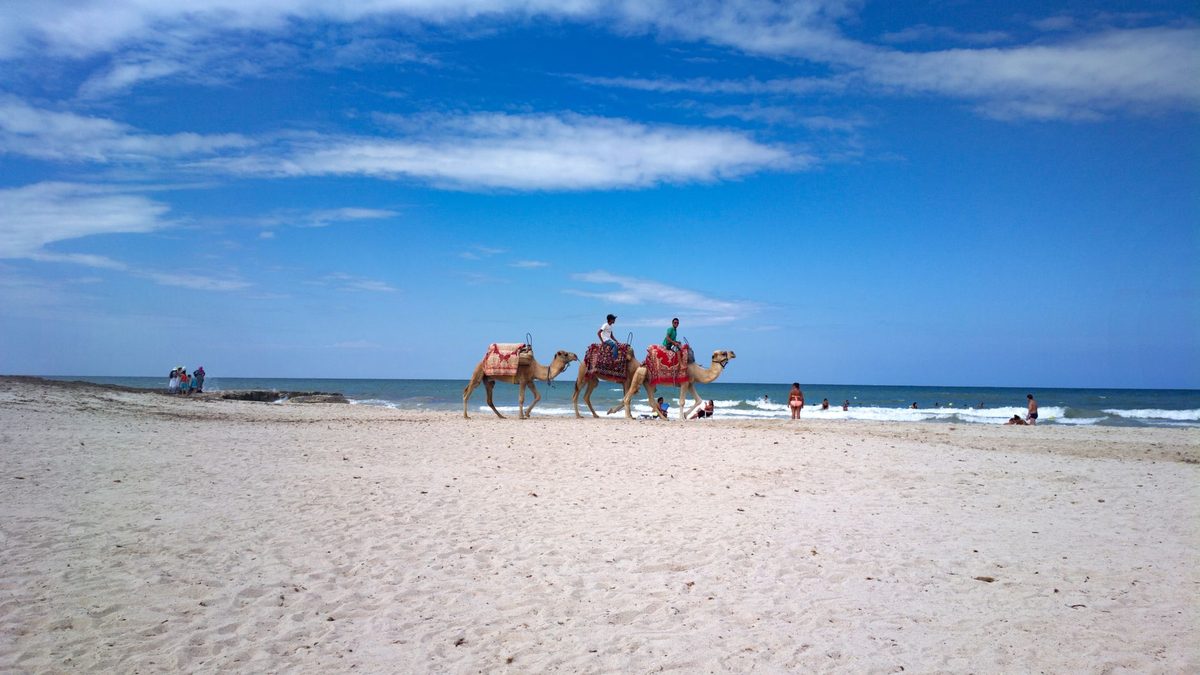
A beach week in Hammamet, Sousse or Djerba
Days by the pool with Wi-Fi at the hotel, a couple of excursions, messages and photos home. Mobile data is mostly used away from the hotel: finding a restaurant, a taxi, a quick look at social media on the beach.
- Quiet days: 100–300 MB.
- Excursion days (Sidi Bou Said, El Jem, a Djerba tour): 300–700 MB.
- Week total: roughly 2–4 GB, less if the hotel Wi-Fi is good and you use it for video.
A city break in Tunis, Carthage and Sidi Bou Said
Out all day, navigating between the medina, the Bardo, the ruins of Carthage and the cafés of Sidi Bou Said; booking rides; checking opening hours; sharing a lot of photos.
- Typical day: 500 MB – 1 GB.
- Week total: roughly 4–7 GB.
A road trip south: Kairouan, El Jem, Matmata, Tozeur, Douz
Long drives with navigation running, hotels that change every night, bookings made on the go. Navigation itself is cheap; what adds up is the planning done on the phone, and the photos. Coverage is generally best in towns and along the main roads; in the desert and remote areas, signal can be weak or absent for stretches, whatever the network.
- Typical day: 400 MB – 1 GB, concentrated in towns.
- Week total: roughly 3–7 GB.
- Essential: download offline maps for the whole route before you leave a good connection.
Who uses much more
- Remote workers sharing the connection with a laptop: a single video meeting or a cloud sync can use more than a gigabyte.
- Heavy social media users with autoplay on: an hour of video feeds a day can mean several gigabytes over a week.
- Families sharing one connection with tablets for the children: streaming cartoons is video.
- Anyone who forgets automatic updates: one system update can exceed a whole day's normal use.
If you recognise yourself here, the hotel Wi-Fi is your friend for the heavy part, and mobile data for everything else.
How a week maps onto our daily rule
Our plans do not sell a pot of gigabytes. Every eSIM Tunisie plan gives 1 GB a day at full 4G speed, then 512 kbps until the daily allowance renews, with no total cap. A 7-day plan (€37) therefore means seven full-speed gigabytes, one per day, and a connection that never cuts out.
Put next to the three weeks above, that fits the beach week and the city break comfortably: most days stay under the gigabyte. The heavier days — a long video call, a feed-scrolling evening — cross it, and the rest of that day continues at 512 kbps, which still handles messages, maps and music at normal quality but not smooth video. We explain what that feels like in Tunisia eSIM unlimited data, explained.
The model suits steady daily use. It suits less well a trip where you want to use 5 GB in one day and nothing on the others: a fixed-data plan, or a local SIM with a large data option, does that better.
Families and groups: one plan or several?
Each phone needs its own eSIM: one QR code installs on one device, and our terms note that an installed eSIM generally cannot be transferred to another phone. Some families try to run everyone from one phone's hotspot. Our terms are clear that connection sharing may be allowed, limited or unavailable depending on the network and the handset, and even when it works, every connected device shares the same daily gigabyte — two teenagers on video apps will use it before lunch. For a family, the practical setup is usually one plan per adult who needs to navigate or be reachable, and the hotel Wi-Fi for tablets.
What a day over the limit looks like
Suppose the city-break day goes badly: a long video call in the afternoon, an hour of feeds on the terrace, and the gigabyte is gone by 6 pm. On our plans nothing stops. The evening's maps still load, messages still arrive, the restaurant booking still opens — just more slowly, at 512 kbps. What becomes impractical is more video. The next day begins with a new full-speed gigabyte. That is the difference between a daily rule and a fixed pot: a heavy day costs you speed for one evening, not the rest of your data for the week.
Wi-Fi in Tunisia
Most hotels and many cafés and restaurants in the tourist areas offer Wi-Fi, and it is the right place for anything heavy: streaming, video calls, photo backup, updates. Its quality varies a lot from one place to another, so do not plan a trip around it. A sensible split is Wi-Fi for the heavy use and mobile data for everything you need while you are out — which is exactly the use a daily gigabyte is sized for. On public networks, avoid banking apps unless you are sure the network is trustworthy.
Other ways to cover a week
- A local SIM. Orange Tunisie's website lists 4 GB for 10 dinars and 6 GB for 15 dinars, valid 30 days — a few euros. It needs your passport at the counter and a physical SIM slot. See Tunisia SIM card at the airport or an eSIM.
- Your home plan. Tunisia is outside the European roaming zone. UK networks treat it very differently — from no data at all to £7–£8 a day — as we found in Tunisia roaming from the UK.
- Another travel eSIM. On the day we compared prices, Airalo's 7-day unlimited plan was cheaper than ours, and Holafly's too. The details, including the networks they use, are in best eSIM for Tunisia.
Seven settings to change before you fly
- Automatic updates: allow them on Wi-Fi only (apps and system).
- Photo and video backup: Wi-Fi only.
- Video autoplay: off in Instagram, Facebook, TikTok, X and YouTube.
- Streaming quality: set a lower quality on mobile data in your video and music apps.
- Offline maps: download every town on your route.
- Messaging media: stop automatic download of videos on mobile data in WhatsApp.
- Data counter: reset it when you land, so you can see what each app uses after a day or two.
Travellers who make these changes routinely find their normal day halves. The single biggest saving is usually the first one.
Choosing the plan length
Because every plan has the same daily rule, you choose by days, not by gigabytes. Count the days you will actually be in Tunisia, including the arrival day if you land in the afternoon. Our durations are 1, 3, 5, 7, 10, 15 and 30 days; the plan starts on your first connection in Tunisia, not when you buy it.
| Your stay | Plan | Price |
|---|---|---|
| A day or a stopover | 1 day | €6.50 |
| A long weekend | 3 days | €18 |
| Four or five days | 5 days | €29 |
| A week | 7 days | €37 |
| Eight to ten days | 10 days | €44 |
| Two weeks | 15 days | €59 |
| Up to a month | 30 days | €99 |
If your stay falls between two lengths, take the longer one: a plan that ends a day early leaves you without data on the day you travel home, which is often the day you need it most.
The departure day deserves a thought of its own. It is usually the day you check a flight time, call a transfer, find a pharmacy for the journey or message someone about the pick-up at home. If your flight leaves in the evening, count that day as a full day of use when you pick the plan length.
A quick way to estimate your own week
If you want a number rather than a range, look at your phone's data usage at home for the last month and divide by 30. Most people find a figure between 150 MB and 1 GB a day. Then adjust for the trip: add some for navigation and photos, subtract what you normally stream at home on Wi-Fi only if you will have Wi-Fi at your accommodation too. Multiply by seven. If the result is well above 7 GB, your week is video-heavy: plan to do that part on Wi-Fi.
Before you buy
Our eSIM is data only — no Tunisian number, no ordinary calls or texts — and runs on the Orange Tunisie network. It is delivered by email as a QR code and our terms exclude the right of withdrawal once it has been issued, so please check that your phone supports eSIM first. All durations are on our plans page, and installation is covered in our FAQ.